Jacopo Menghini (PhD graduate, University of Bologna)

The ‘Mark Violets’ rumor
July 13th 2024 will be remembered as the day of the assassination attempt on Donald J. Trump, who would eventually be elected for his second mandate as President of the United States. As a result of the attempt, Trump was only slightly wounded. The gunman was immediately shot down by secret service agents. News outlets set out to work from the campaign event in Butler, Pennsylvania, reporting on the former president’s condition as accurately as possible. In this context of enormous fear and concern for the fate of the US, the free flow of information played a key role in explaining the situation on the ground.
Social media fits perfectly into this information cycle, as they are typically first to break the news. For example, many social media users who witnessed the attack denounced the delay in the security services’ intervention. The main problem with this medium of communication, however, is the lack of intermediation. Whereas traditional Radio, TV and newspapers are run by trained journalists and editors who assess, judge and convey the news, digital platforms often lack a gatekeeper. Social media platforms are only able to intervene in a limited range of cases, e.g. contents from media outlets which have a pre-publication assessment, while most user-generated or created content spreads across the web without any preemptive filter. The type of content that has caused the most problems in recent years, due to the complexity of assessing risk, is what is usually called fake news.
The difficulties of evaluating fake news are highlighted in this talk by Anya Schiffrin, which provides a taxonomy of solutions to online fake news and disinformation, based on both the financial interests involved and the beliefs to be protected. In the age of online information, for example, journalists are trying to protect their category by imposing standards of ethics and probity to build trust with readers through fact-checking, which other content creators often do not comply with. In particular, the online information flow concerning the assassination attempt on Donald J. Trump has highlighted a series of topical issues related to fact-checking on online platforms.
In the minutes following the failed assassination, the question on everyone’s mind was: who did it? Although it was easy to answer that question, as the gunman had died at the scene and his identity was already known to the authorities, a curious piece of fake news achieved global circulation. On the social media site “X,” an Italian user called @Moussolinho tweeted that the gunman was Mark Violets, an Italian YouTuber – whose real name is Marco Viola – often targeted for his ridiculous way of presenting himself to the public. The tweet was meant as playful banter between two users who often teased each other on social media, thereby entertaining their close circle of followers. This was the text of the ironic tweet:
BREAKING: According to the Butler Police Department the #Trump shooter has been arrested at the scene and has been identified as Mark Violets, a rabid antifa member. Before the attack he uploaded a video on YouTube claiming justice was coming.
The tweet is a humorous attack that has no connection with reality; the account name clearly does not indicate an official source, and there is no Butler Police Department. Nevertheless, within minutes of the tweet being published, several official newspapers and television stations in North and South America began to report the tweet as official news. The joke went viral worldwide, with no way for its author to retract it. The face of Mark Violets was revealed to the public, who believed the news. The scandal eventually subsided, but more slowly than the fake news had spread, in compliance with Brandolini’s law (“The amount of energy needed to refute bullshit is an order of magnitude bigger than that needed to produce it”). It is hard to imagine the repercussions on the private life of this Italian citizen who was accused of attacking Donald J. Trump; he recently declared his intention to sue Elon Musk, which is somewhat ironic as well. What is certain, however, is that X has not censored the profile of the author of the fake news, who continues to use the platform and boasts about the global impact of his hoax. This case highlights a very important aspect of online irony: humour can have effects beyond the control of its author, and can quickly turn into potentially harmful expression by becoming fake news on social media.
The tweet certainly demonstrated how, when content is re-shared by many users, the context needed to understand the original author’s joke is lost. For this reason, some social media platforms have specific guidelines for content, such as parody or satire; they require that the intention to create a parody account be disclosed, for example by stating it is a parody in the bio (see X’s authenticity guidelines, for example). The sad version of ‘link in bio’. This policy appears to embrace the concept of Poe’s Law (“Without a winking smiley or other blatant display of humor, it is utterly impossible to parody a Creationist in such a way that someone won’t mistake for the genuine article”); however, as argued in a recent ForHum post by Babette De Naeyer, such an approach seems to defeat the very purpose of humour and satire, which often rely on an initial phase of confusion leading to the eventual recognition of the joke. A related incident happened on Twitter a few years ago. JD Wetherspoon, the famous UK pub chain, made the bad decision to deactivate its official Twitter profile. A witty user took the opportunity to create a “parody account” and began posting satirical content on behalf of the real pub chain. This was found to damage JD Wetherspoon’s reputation and market position.
Online humour, ‘serious’ reporting and potential harm
The humorous revisiting of current events is a form of entertainment which plays an important role in public life. Online humor can also have a relationship with reporting, as the Mark Violets fake news has shown. At the same time, humor deserves some sort of autonomy from the legal provisions affecting serious reporting. After all, when humor informs, it does so through a mixture of true and plausible facts that are created to induce laughter. What distinguishes humor from plain reporting, then, is creativity – a necessary and fundamental component for the reworking of news in order to provoke laughter, amusement and satirical reflection. In this sense, humor, precisely because of this creative component, cannot fulfil the duty to inform, which means that the standards imposed on fair reporting do not apply. Humor, parody and satire can be considered sui generis forms of reporting or criticism (another form of expression often associated with humor), without the legal limits imposed on them.
If humor cannot inform, however, it can certainly misinform, as Claire Wardle pointed out in a 2020 report underlining how humor is often used to “bypass fact checkers and to spread rumors and conspiracies”. There are numerous examples of humorous content intended to fool audiences. This flow of content increases enormously in the run-up to major events, such as political elections. Claire Wardle cites examples occurring during the American, French and Brazilian presidential elections, when parody accounts proliferated using puns related to politicians or high-profile journalists. Such content amounts to deliberate distortion of facts, but does not necessarily aim to mislead. This clarification is in order, as the primary purpose of humor is not to provide information. Therefore, parody and satire would be more like misinformation, which spreads inaccurate information without malevolent intent, while disinformation must be characterized as false, inaccurate information designed to intentionally cause harm.
A humorous attack, even one which contains misinformation, can be considered an acceptable form of social criticism against politicians. Satire and parody, for example, are considered the least problematic cases of misinformation by Claire Wardle, as they typically have no intention to harm even if they do have the potential to fool. However, a different assessment should be made when the subjects targeted are ordinary citizens. In the latter case, in fact, the raison d’etre would collapse, since satire and parody have always been an effective instrument to criticize political leaders rather than mock private citizens.
Humor stresses the difference between public and private figures when it comes to the protection of freedom of expression, on the one hand, and the protection of the reputation, on the other hand. If, in the case of a private individual, the protection of the reputation and of correct and truthful information must be guaranteed at the highest level, in the case of public figures (and especially politicians) the limits of acceptable expression are broader and can therefore lead to humorous attacks geared towards social criticism. In Lingens v. Austria, the European Court of Human Rights has highlighted the relevance of this distinction between politicians and private individuals with respect to Article 10 ECHR.
The Mark Violets tweet created disorder around the political event of the year, making light of the attempted assassination of Donald J. Trump, but did so by exposing a private citizen and destroying his privacy. In this case, online humour reveals a worrying aspect – the targets of online attacks are often not politicians, but ordinary people made famous because of a post which has gone viral, people who have nothing to do with power and responsibility in public life. It may thus be appropriate to regulate certain forms of humour, not so much because of the message they convey – indeed, I do not wish to advocate censorship of ironic content, which is a vital manifestation of freedom of expression – but rather based on the public or private status of the targets. The so-called side-effects that some online content produces, as in Mark Violets’ example, confirm the very real dangers of online misinformation.
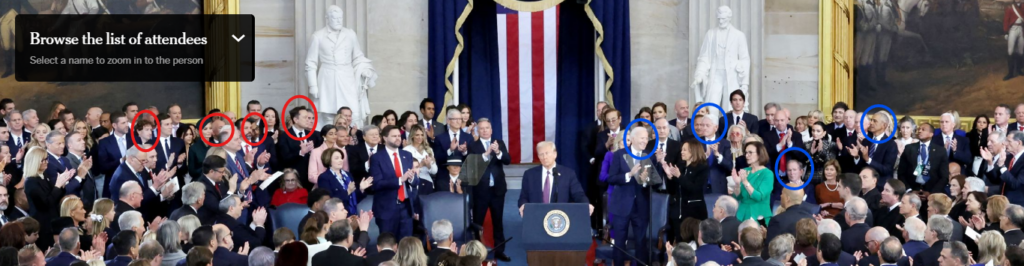
Nevertheless, any consideration of intervention on freedom of expression should be particularly careful when humor is concerned – including humor that might “offend, shock or disturb”, as famously stated by the European Court of Human Rights in Handyside v. United Kingdom. The regulation of online humor, and of online freedom of expression at large, is now largely delegated to online platforms, which begs the question: Who decides when humor is fair? This shift in power, or the different allocation of power in the age of social media, may also challenge the freedom of humor. When online platforms unilaterally manage artistic content, they exercise considerable authority over both the recognition of creativity and the protection of freedom of expression. There is an image that best explains this shift. During his inauguration speech, President Trump was reading at the center of the stage, and to his left were sitting four former presidents of the United States – Bill Clinton, George W. Bush, Barack Obama and Joe Biden. To his right, four personalities from the most innovative tech companies of our time were lined up, namely Elon Musk (X), Mark Zuckerberg (Meta), Jeff Bezos (Amazon) and Sundar Pinchai (Google). If my joke made those on the left laugh, I would be pleased. If it made those on the right laugh, I would be relieved.