Dr Jennifer Young and Professor David Mead (University of East Anglia)

Protest is under pressure in the UK (and unfortunately, it’s not the only place). Recently a number of reforms have been passed which all created new powers for the policing of protests. These are namely the Police, Crime, Sentencing and Courts Act 2022, the Public Order Act 2023 and the Public Order Act 1986 (Serious Disruption to the Life of the Community) Regulations 2023. This is all very disturbing for those who understand the democratic importance of freedom of expression and the right to protest.
Adding to this has been the proscribing of the direct-action group Palestine Action classing it as a terrorist organisation. This followed incidents in which members of the activist group broke into properties, including RAF (Royal Air Force Base) Brize Norton in Oxfordshire where they sprayed two planes with paint. Previously the group had broken into a defence factory in Glasgow causing over one million pounds worth of damage.
In July 2025 Members of the British Parliament voted to add Palestine Action to the list of “proscribed organisations” under the Terrorism Act 2000, the first time a non-violent direct-action group had been classified in this way. As well as banning the group, as from midnight on 5th July, it became a criminal offence to express support for the group or be a member of the group with a punishment of up to fourteen years in prison. Such expressions of support included wearing clothing or carrying/displaying an item that would arouse reasonable suspicion that someone was a member, with a penalty of six months. The Group challenged the decision and there will be a full judicial review of the legality of the decision in November 2025.
The proscribing of Palestine Action caused controversy to say the least. Protestors came out to oppose the proscription and over 500 people were arrested on one single August Saturday in London for carrying placards in support of the group. Yet whilst the Terrorism Act creates the offence of support for a proscribed group, officers are not duty bound to arrest these supporters, they should exercise discretion and consider the protesters’ free speech rights.
You might be forgiven for wondering what all this has to do with humour. All this leads us to an ex-headmaster and the front page of the British satirical magazine Private Eye.
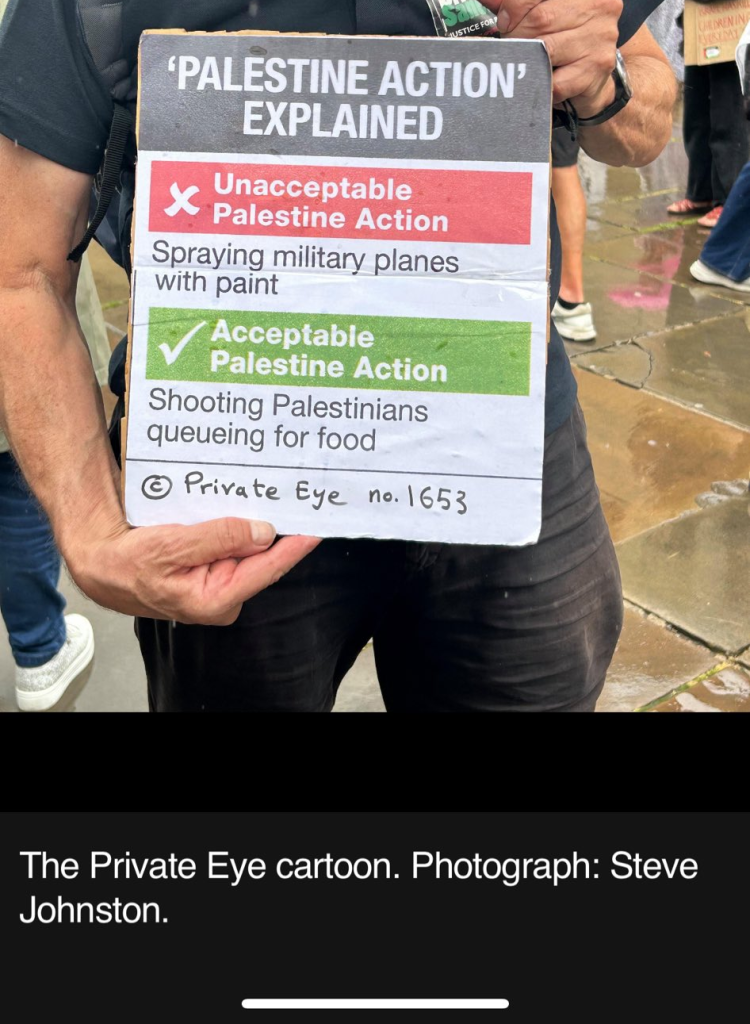
John Farley, an ex-head teacher, took part in a silent demonstration in Leeds, England to protest against the war in Gaza. He was carrying a placard with a printed version of a Private Eye front page. The police arrested him under the Terrorism Act on suspicion of demonstrating support for a proscribed organisation on account of his placard. He was taken to a police station and interviewed by counter-terrorism officers. After six hours he was bailed on the condition that he would not attend any Palestine Action rallies (which he had never attended) and later told that he would face no further action.
He stated that he was told by police that the cartoon was fine in print but illegal if it was carried on a demo and considered that this sounded like the police ‘making up the law’. Ian Hislop, the editor of Private Eye and regular commentator on freedom of expression and political satire, called John Farley’s arrest ‘mind-boggling’.
As if the police’s actions in the case above were not mind-boggling enough, the police also arrested a man at a Gaza protest for wearing a T-Shirt which parodied the logo of Palestine Action, replacing the proscribed organisation’s name with the words “Plasticine Action” and including a plasticine character made famous in a British children’s programme in the letter O.
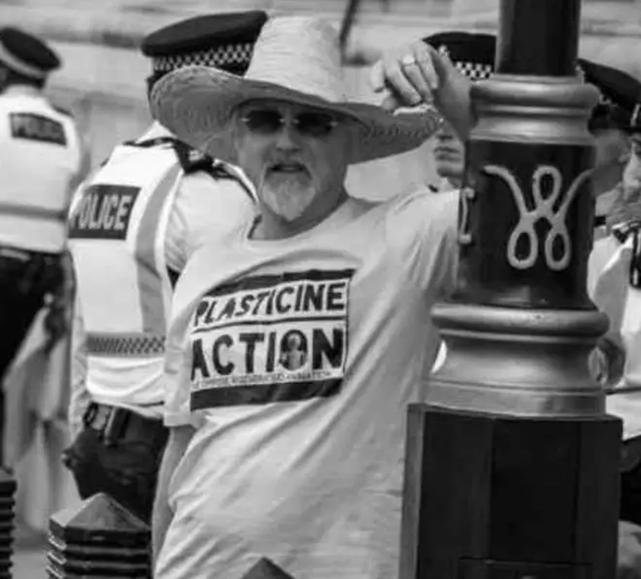
As in the case of John Farley, the wearer of the T-shirt, Miles Pickering, was arrested under the Terrorism Act 2000. He was taken to Scotland Yard where he was de-arrested once the officers realised what was written on the T-shirt. He admitted that the T-shirt was deliberately designed with a logo that looked like the Palestine Action logo.
Of course, there is a serious side to all this humour, which we have already touched upon. That is the potential chilling effect (when people don’t exercise their rights because they are concerned about negative consequences such as legal sanctions) that such arrests will have on freedom of expression and those who may want to attend a demonstration. If the broad nature of the current legislation on protest is not clear to police officers, then it follows that the public is unlikely to know where the legal boundaries lie.
A chilling effect is problematic in terms of participatory democracy. It takes someone brave or foolhardy to continue to protest in the face of a police warning to stop, and most of us are neither. Yet the harm is even greater because if I am “chilled” and remain muted, you won’t hear what I was going to say…and we all lose out from the silencing of just one of us.