
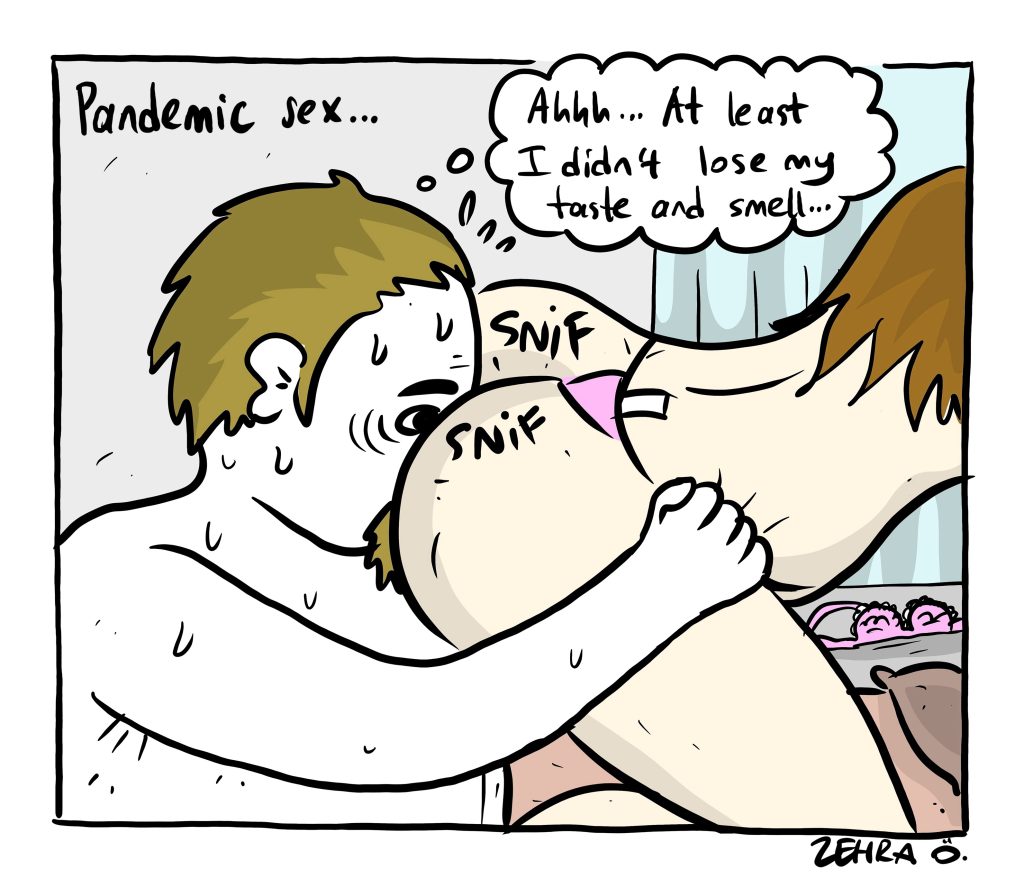
Mode of expression: Cartoon
Publication: LeMan
Region: Turkey
Relevant dates: 25 November 2020 – present
Outcome: Pending
Judicial body: 2nd Istanbul District Court
Type of law: Civil law
Themes: Public Morals
Context and legal case
On 25 November 2020, the Turkish cartoonist and illustrator Zehra Ömeroğlu published a cartoon in the humor magazine LeMan. The cartoon was not explicitly political; instead, it commented on life during the global Covid-19 pandemic. The (translated) caption of the cartoon reads “Pandemic sex…”, and the cartoon itself depicts a man is rubbing his face in the genitals of a woman, accompanied by an onomatopoeic text, “snif, snif,” to indicate that he is in the process of smelling. A thought bubble appears above the man’s head with the text “At least I didn’t lose my taste and smell…”
Just a few weeks later, on 14 December 2020, the Istanbul Chief Public Prosecutor’s Office initiated proceedings against Ömeroğlu for obscenity. If found guilty, Ömeroğlu could face a fine and up to three years in prison. Since the start of the legal proceedings, the process has been characterized by delay upon delay. Ömeroğlu first appeared before the 2nd Istanbul District Court on 27 May 2021. On 5 October 2022, she appeared again before the 2nd Istanbul District Court, following the opening of an ex-officio accusation for obscenity prepared by the Istanbul Prosecutor General’s Office.
During the hearing, her lawyer stated that the cartoon, drawn at the beginning of the pandemic, depicted a human situation only to make people laugh during the lockdown. He also added that, “according to the decisions of the Constitutional Court, the presence of an erotic element is not a crime.” Still, the public prosecutor asked the Obscene Publications Commission (Muzır Neşriyat Kurulu), which is linked to the Ministry of Family and Social Services for the Protection of Minors, to produce a report determining whether the cartoon is obscene or not.
Since then, her trial, initially scheduled for 17 October 2022, has continued to be postponed. During a hearing on 9 January 2024, yet another postponement was recorded on the grounds that the Obscene Publications Commission had still not submitted its report to determine whether or not the cartoon was obscene. This marked the third time that the report, without which a trial cannot proceed to a conclusion, was delayed.
The report was finally issued on 8 March 2024. The Obscene Publications Commission concluded that Ömeroğlu’s cartoon was obscene. Another hearing took place on 16 April 2024, but the trial was postponed once again, this time due to the absence of the judge in charge of the case.
Years later, as of April 2025, the cartoonist is still waiting in fear of a criminal conviction. The next hearing has been set for 26 September 2025. The multiple postponements of Ömeroğlu’s trial likely constitute a violation of the right to be tried within a reasonable time, as guaranteed by Article 6 of the European Convention on Human Rights.
Analysis
Although Turkey is bound to protect freedom of expression, guaranteed by Article 19 of the International Covenant on Civil and Political Rights and by its own Constitution, which also guarantees freedom of the press and the free dissemination of art, the country is ranked 159 of 180 countries in the Reporters without Borders World Press Freedom Index 2025.
This contradiction between what should be allowed in Turkey and what is actually possible creates a situation of risk and uncertainty for satirists in Turkey. Without clear red lines it is almost impossible to determine when a cartoon “goes too far.” This uncertainty creates an environment in which cartoonists are ever mindful of what they make and if it could cause trouble for them. An environment fostered by authorities to keep cartoonists in line.
We can discern two strategies in the Istanbul Chief Public Prosecutor’s approach to the case that are often employed by regimes looking to crack down on political satire and undermine freedom of expression.
The first of these strategies is not to attack explicitly political satire, but to use laws that forbid indecent, sexual, or supposedly blasphemous content, claiming it undermines morality and threatens traditional or national values. This allows the regime to claim the moral high ground, while distancing themselves from any allegations of political censorship, with the larger aim of staying in power. Attacking cartoonists for supposedly indecent work also serves as an effective deterrent to political satire, as the charged cartoonist will think twice before making any more cartoons that could lead to legal charges or other forms of political harassment.
One could also argue that this strategy is thought to be particularly effective when employed against female cartoonists. Traditionally, women have been held to a higher moral standard than men, especially when it comes to sexuality. To accuse a woman of indecency involves a higher degree of shame.
The second strategy is simply delay. Although jailing opponents and critics can be effective, authoritarian regimes benefit even more from creating a climate of uncertainty. Cartoonists that have one or more pending cases against them will most likely be more careful with the work that they produce, which is exactly what the regime is aiming for. Furthermore, colleagues of cartoonists that face years of legal proceedings will also be affected by this and will want to avoid a similar fate.
Sources and further reading:
Cartooning for Peace – Alert Hungary – Zehra Ömeroğlu: https://www.cartooningforpeace.org/en/soutiens/alerte-turquie/
Cartoonists’ Rights: Türkiye: censors find cartoon criminally “obscene”
https://cartoonistsrights.org/zehra-omeroglu-cartoon-found-obscene