Jennifer Young (Postdoctoral researcher, ‘Humour in Court’ project, University of Groningen)

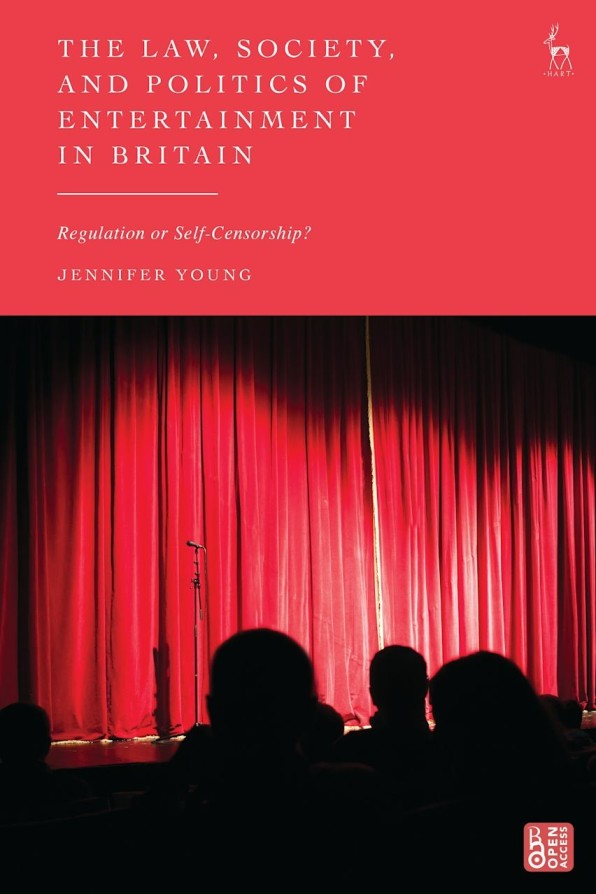
We are delighted to publish this contribution by ForHum founding member Jennifer Young, regarding her new (and warmly recommended!) book on satire regulation and (self-)censorship in Britain.
Finally, my book is out in print, have you all been waiting on tenterhooks for it? Maybe not, maybe you weren’t aware of it. If it’s the latter, then please give me the opportunity to tell you about it.
Many years ago, when the world wasn’t quite so mad, and looking at the news in the morning didn’t necessarily involve breaking out in a cold sweat with the added fear of impending doom, I used to work in television, specialising in comedy. I held various editorial roles. Towards the end of this period of my life I was a broadcasting consultant, having been a Compliance Adviser, working my way up the ranks to Senior Adviser for both public service and commercial channels.
The compliance aspect of the role was to ensure that the programmes we broadcast complied with the law and regulations which govern British television and radio. We also had to comply with the channels’ in-house editorial guidelines. My job included reading scripts and viewing “rough-cuts” – these are the early versions of programmes before the production teams make the final ones for transmission. I would check the content against the regulations and the guidelines and suggest necessary edits or re-word scripts when I thought they did not comply. I would also view archive programming, sometimes first broadcast decades ago, and advise if they needed content edited out because of the changing sensitivities of modern audiences. I was, and still am, fascinated by the regulations and the (sometimes subjective) editorial decisions made on the grounds of what was known as “taste and decency”. These are now categorised as “harm and offence”. I had to judge what level of offence might be deemed justifiable, or appropriate by the audiences or by the regulator.
At the same time, I undertook a master’s degree in Media Law, and I chanced upon the Victoria and Albert Museum’s exhibition Censored! Stage, Screen, Society at 50. If you have never visited the Victoria and Albert Museum, I urge you to do so when you are next in London, it’s excellent. This exhibition marked the 50th anniversary of the Theatres Act, which abolished state censorship of the theatre in Britain.
This state censorship was brought in by a draconian law, the Stage Licensing Act 1737. The Act effectively meant that political satire was banned from stage plays; in fact, it was problematic to allude to any kind of contemporary political situations or politicians. The Act stemmed from a rather thin-skinned British Prime Minister. The increasing popularity of political theatre meant the PM (Walpole) and his corrupt Government were a rich source of satirical material. Walpole introduced the Act to stifle anti-government feeling. This meant that anything which might damage the British Government’s reputation could be legitimately censored. It followed that stage plays had to be approved by the Lord Chamberlain. It wasn’t until the 1960s that a politician was parodied on a West End stage.
In the V&A’s exhibition there were examples of scripts with comments illustrating what had been cut or rejected by the Lord Chamberlain’s office before plays could be performed in public. This led me to draw comparisons between the Lord Chamberlain’s work and my time as an editorial compliance adviser.
I was then funded to do a PhD on the regulation of political entertainment, and the book is based on this research. It traces the beginning of state censorship using historical sources and brings the arguments for and against state regulation into the present day. One of the subjects that the book discusses is the torturous process of bringing cameras into Parliament. One reason that the MPs did not want cameras was that they did not want their behaviour to be the target of satirical attack. This was so keen a problem for some of them that the rules of coverage still stipulate parliamentary footage cannot be included in satirical programmes. And now we have the torturous situation where politicians present television programmes and run their own social media accounts, I’m not sure what is worse for democracy. There are also other examples in the book of how politicians fear satire and Professor Little’s excellent blog here shows how this is reflected in the States too.
I believe the most interesting chapters in the book are the interviews with industry professionals. These range from stand-up comedians to a member of the House of Lords (who also happened to be the Chair of Ofcom – the British Broadcasting regulator), producers, editors and political advisers. The interviews explore the process which industry professionals use when deciding what to include in a programme and what to edit out. The book challenges the idea that regulation dictates editorial choices and creates a cancel culture. Often a fear of an audience backlash can decide what ends up on the cutting room floor. Sometimes it is broadcast practitioners who decide the limits of offensive humour rather than regulation or legislation. But sometimes the regulations do have a stifling effect, especially those on impartiality which have a significant impact on political entertainment as a tool to drive democratic debate.
Often it is a misinterpretation of the British broadcasting impartiality requirement which can undermine political satire’s role in encouraging democratic engagement. Satire is a powerful and appealing way to expose political hypocrisy. It can be offensive and provocative, sparking debates about the limits of freedom of expression and the harm in humour. Whilst the book focuses on broadcasting regulations, in the interviews it became clear that comedy writers do not.
The book also illustrates how political satire might be smoothed out because of fears of offending audiences or a backlash from the audience who then ‘cancel’ performers. Worse still, a timid approach to programme making can mean that ideas are never explored so leaders who deserve satirical attack are never targeted. There is damage to democracy when production teams misinterpret rules. The way in which the British regulatory frameworks have evolved has impacted on the creative industries. This has left the audience unchallenged, uninformed, and politically disengaged.
I hope you consider reading the book, I have had feedback from one person so far, one of my contributors, Shane Allen, the Controller of Comedy Commissioning at the BBC at the time of interview. He said of the book, “It’s terrific, so many terrific names and interesting perspectives. It’s a masterpiece…”. Although he does have a wicked sense of humour.
This book is essential reading for people keen to understand the editorial process and the effects of ‘cancel culture’. You can buy it or go online and download it for free. After all, it is terrific.
Bloomsbury Collections – The Law, Society, and Politics of Entertainment in Britain