Camila de la Fuente Sandner (cartoonist and illustrator, Mexico)
This contribution was originally published in Spanish on Camila de la Fuente Sandner’s Substack ¡Basta de contenido inmemorable!. We thank the Author for allowing us to republish her reflection, and we recommend subscribing to her Substack 🙂
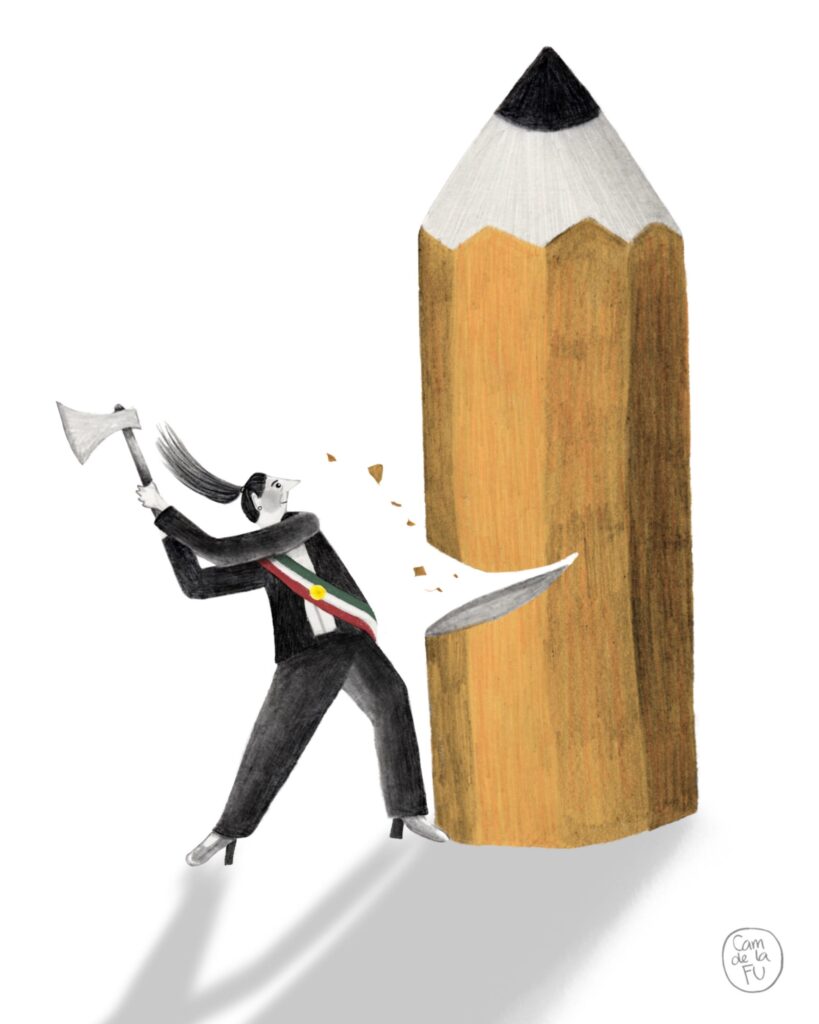
Cartoons have always made those in power uncomfortable. Now, those in power want to make things legally uncomfortable for those who draw them.
Let me provide some context. The so-called “Anti-Meme Law” actually consists of two reforms. One is to the Federal Penal Code and the Law on Industrial Property, and it punishes the misuse of official government logos and symbols for committing crimes, such as impersonating a public institution for illicit purposes, with up to five years in prison. That one has already passed through the Senate, but… there is another reform in the Chamber of Deputies that is causing more concern: a reform to the Federal Law on Copyright, proposing that internet service providers and platforms be held jointly responsible for what their users upload.
The problem is that platforms and internet providers will want to delete posts to avoid the risk of a multi-million peso fine. They usually operate in this way: they won’t review each post individually; they use automated systems to remove any content that appears to infringe copyright, and in that process, memes, cartoons, or criticisms that use images of the government, even if they are protected by freedom of expression, may be removed. The algorithm does not distinguish between the misuse of the government’s image and a political criticism or a joke. It puts everything in the same bag.
It is cheaper to delete content than to defend it.
This resonates strongly with what Polish journalist Ryszard Kapuściński said at one point: “when it was discovered that information was a business, truth ceased to be important.” There is no doubt what weighs the most.
Another thing that is very worrying is that repeat offenders—such as a cartoonist, for example—are at risk of having their accounts deleted after several “violations,” therefore losing their platform for showcasing their work to the world and earning a living.
In Europe, something similar to the Anti-Meme Law already exists, but with the HUGE difference that it includes a section that protects satire and humor. This latter aspect does not exist in Mexico, and that is why this very dangerous gray area arises.
Those who defend the reform say it is to prevent fraud or deception; and of course, we all agree that anyone who commits such acts should be punished. But there is a huge legal loophole in which authoritarianism can operate as it pleases. What exactly amounts to ‘fraud’ is open to interpretation: Who decides whether something is deception or humor? There are no safeguards or a clear list of exceptions for satire. It is not prohibited, but it is left exposed. The question we have to ask ourselves is why don’t they protect it?
Furthermore, the law is ambiguous enough that one might hesitate before publishing, unsure whether they have crossed the imaginary line. A line that shifts according to the convenience of those in power. And what does this legal uncertainty generate? It leads one to begin self-censoring in order to avoid any problems.
I read an article by Denise Dresser on this topic, and I love what she says: “A powerful person who only tolerates humor when it is directed at someone else is not defending freedom of expression. They are defending their right not to be bothered. That is why the law must be written with a scalpel and not with an axe.”
I find it very worrying that this issue is not being discussed more. The most difficult dictatorships to overthrow are those that gradually gain ground without anyone realizing it, precisely by leaving these legal loopholes that they interpret to their advantage. When there are politicians hungry for power, they try to close down spaces for thought: political cartoonists shake up public opinion, so they try to erase their work.
The good thing is that humor knows how to turn everything around. It will be challenging, but I think it’s possible to outsmart censorship if one is clever enough. Cartoons have the ability to wink at the reader, to depict power without actually depicting it.
Those in government are not exempt, because in the end, ironically, in graphic humor, the image itself is not so important. As Laureano Márquez, a humorist whom I greatly admire, says: “The flaws that interest a caricaturist are not the physical ones, but the moral ones, which are not only the only ones that truly make a person ugly, but they are also the only ones that one can change with willpower.”